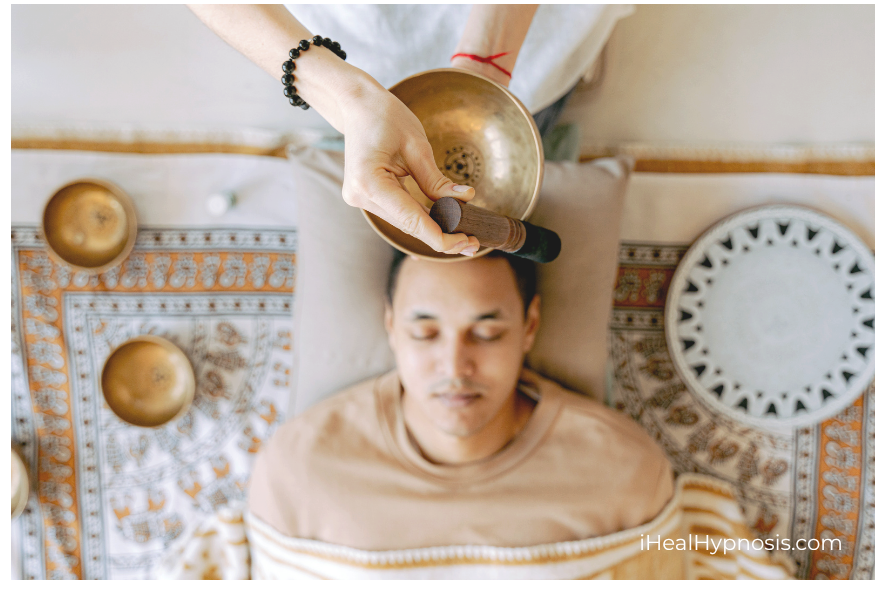



The Science of Sound:
How Frequency Heals the Human Body
Have you ever noticed how a certain song can stop you mid-breath — shifting something deep inside before your mind even catches up to what’s happening?
That’s not just emotion. That’s your body responding to frequency.
Sound is one of the oldest healing tools on Earth. From the resonant hum of Tibetan singing bowls to the choral harmonics of ancient temples, human beings have long understood — intuitively — that certain sounds do something to us. Now, a growing body of scientific research is beginning to explain why.
In this post, we’re exploring two powerful areas of sound therapy — Solfeggio frequencies and binaural beats — and what the latest research tells us about their ability to reduce stress, support sleep, ease anxiety, and create measurable shifts in the body’s chemistry. Whether you’re completely new to sound healing or already integrating it into your wellness practice, this is for you.
What Is Sound Therapy — and Why Does Frequency Matter?
At its most basic level, everything in the universe vibrates. Your cells vibrate. Your organs vibrate. Even your thoughts carry a frequency. Sound therapy works on the premise that these vibrations can be influenced, balanced, and restored through carefully chosen sound frequencies.
Think of it like tuning a guitar. When a string falls out of tune, it creates dissonance. Sound therapy is, in essence, the act of returning the body’s “strings” to their natural resonance — allowing the nervous system to settle, the mind to quiet, and the body’s own healing intelligence to come forward.
Two of the most studied tools within this field are Solfeggio frequencies and binaural beats. Both use specific tones to influence the body—but they work in different and complementary ways.
Solfeggio Frequencies: Ancient Tones, New Science
Solfeggio frequencies are a set of tones — ranging from 396 Hz to 963 Hz — believed to carry unique healing properties. You may have seen them referenced alongside the chakra system, as each frequency corresponds to an energy center in the body.
Their modern rediscovery is credited to Dr. Joseph Puleo, who in the 1970s researched numerical patterns embedded in the Book of Numbers and identified a sequence of tones connected to ancient Gregorian chants. His findings, later co-published with Dr. Leonard Horowitz in Healing Codes for the Biological Apocalypse (1999), reignited interest in frequency-based healing.
But here’s where it gets fascinating: science is beginning to catch up.
528 Hz — often called the “Love Frequency” — has the strongest research record of all the solfeggio tones.
A peer-reviewed study published in the journal Health examined the effects of 528 Hz music on the endocrine system. The results were striking: after just five minutes of listening, cortisol levels (your primary stress hormone) dropped significantly — from 0.43 to 0.25 µg/dL — while oxytocin (the bonding and trust hormone) nearly doubled, rising from 37.57 to 73.58 pg/mL.
Additional research on 528 Hz has shown reduced oxidative stress in brain cells, and studies on animal models suggest it may support hormonal balance by influencing gene expression related to steroid production.
While the research on other solfeggio frequencies (396 Hz, 417 Hz, 639 Hz, 741 Hz, 852 Hz, 963 Hz) is still in its early stages, the measurable physiological effects of 528 Hz give us reason to explore further — with both curiosity and discernment.
Binaural Beats: Tuning the Brain Like an Instrument
Binaural beats work differently than solfeggio tones, but the premise is equally elegant. When two slightly different frequencies are played simultaneously — one in each ear — your brain perceives a third tone equal to the difference between them. This is called the frequency following response.
For example: if your left ear hears a 100 Hz tone and your right ear hears 110 Hz, your brain generates a 10 Hz beat — which falls in the alpha brainwave range, associated with relaxed, calm awareness.
This phenomenon was first documented by physicist Heinrich Wilhelm Dove in 1839 and was later brought into modern neuroscience through Dr. Gerald Oster’s landmark 1973 paper in Scientific American, “Auditory Beats in the Brain.”
Today, the research on binaural beats spans anxiety, sleep, pain, cognitive function, and trauma recovery:
Anxiety reduction: A systematic review found binaural beats produced a 26.3% reduction in anxiety, compared to 11.1% with general music and just 3.6% with no audio.
Sleep quality: A 2022 study on delta-range binaural beats (1–4 Hz) found significant improvements in sleep quantity, quality, and post-sleep mood, with measurable reductions in anxiety and emotional reactivity.
Chronic pain: Research on theta binaural beats (4–8 Hz) in chronic pain patients showed significant improvement in multimodal pain scores after a one-week protocol.
Insomnia: EEG recordings confirmed that theta binaural beats altered actual brainwave activity in participants with primary insomnia, with corresponding improvements in sleep satisfaction.
It’s worth noting that not all studies are equal — individual responses vary, and the effectiveness of binaural beats depends on factors like the duration of listening, the specific frequency used, and the listener’s baseline brain activity. But the body of evidence is growing, and it’s pointing in a hopeful direction.
Sound as a Gateway to Deeper Healing
What makes sound therapy so profound isn’t just its measurable effects on hormones and brainwaves — it’s what those shifts make possible.
When the nervous system moves out of fight-or-flight and into a state of deep rest, the body’s natural healing processes are activated. Inflammation decreases. Immune function improves. The subconscious mind becomes more accessible.
This is why sound therapy is such a powerful companion to other healing modalities — including hypnosis, meditation, grief work, and trauma recovery. It doesn’t require you to “do” anything. It simply invites your body to remember its own capacity for balance.
At ihealhypnosis.com, we integrate sound and frequency into our approach to holistic healing because we understand that true transformation happens on every level — body, mind, and soul. Sound is one of the most direct bridges between them.
Signs You May Be Ready to Explore Sound Healing
Sometimes the soul calls us toward something before the mind has a framework for it. Here are a few signs that sound therapy may be part of your healing path:
- You feel chronically stressed, anxious, or “wired but tired” — and traditional approaches haven’t brought lasting relief.
- You struggle with sleep and wake feeling unrested, even after a full night.
- You’re processing grief, trauma, or emotional patterns that feel lodged in the body, not just the mind.
- You’re curious about vibrational healing and feel intuitively drawn to frequency work.
- You’re already on a healing journey and looking for complementary tools that support deeper states of rest and integration.
If any of these resonate, you’re already asking the right questions.
You Were Designed to Heal
Sound therapy isn’t a trend. It’s a return — to the understanding that the body is an intelligent, frequency-sensitive system that knows how to heal when given the right conditions.
Whether you’re drawn to listening to 528 Hz music during meditation, exploring binaural beat recordings for sleep, or integrating sound therapy as part of a deeper healing practice, trust that pull. Your body is already listening.
If you’d like to learn more about how we weave sound, light, and consciousness-based healing into our work, visit us at ihealhypnosis.com. We’re here when you’re ready.
Sources & Further Reading
- 528 Hz & Endocrine System (cortisol/oxytocin study): https://www.scirp.org/journal/paperinformation?paperid=87146
- 528 Hz & Testosterone / Oxidative Stress (PubMed): https://pubmed.ncbi.nlm.nih.gov/30414050/
- Binaural Beats Systematic Review — Anxiety & Depression (MDPI): https://www.mdpi.com/2076-3417/14/13/5675
- Delta Binaural Beats & Sleep Quality (PMC 2022): https://pmc.ncbi.nlm.nih.gov/articles/PMC9125055/
- Theta Binaural Beats for Insomnia (PMC): https://pmc.ncbi.nlm.nih.gov/articles/PMC10700810/
- Theta Binaural Beats & Chronic Pain: https://pubmed.ncbi.nlm.nih.gov/26773319/
- Dr. Gerald Oster — “Auditory Beats in the Brain” (Scientific American, 1973): https://www.amadeux.net/sublimen/documenti/G.OsterAuditoryBeatsintheBrain.pdf